Living together
Questions to ask before moving in together (and a checklist)
The questions that matter before moving in together are about money, chores, space and what moving in means to each of you. Ask them before you sign the lease, write down what you agree, and check in again after a month.
By Jack JonesPublished 10 min read
The short version
- Start with why: is moving in a step toward a shared future, a way to save on rent, or a test? Different answers are fine; surprises aren't.
- Money is the big one: how you split rent and bills (50/50 or by income), whether you'll combine anything, and any debt you're bringing.
- Agree chores, guests and alone time with specifics (who does what, how often), not good intentions.
- Talk about the exit plan while you're happy: whose name is on the lease and what happens if it doesn't work out.
- Use the printable checklist to agree it in one evening, then check in after the first month.
How to use these questions
This isn't a quiz to pass. Most couples who move in together will disagree on a few of these, and that's the point: it's much easier to find out you load the dishwasher differently, or think about money differently, over dinner than in week three with a sink full of plates.
- Ask them before you sign anything. A lease is the hardest part to undo.
- Both of you answer every question. Take turns going first.
- Aim for a decision, not a debate. "We'll figure it out" isn't an answer to "who pays the electric bill?"
- Write down what you agree. The checklist below has a line for each decision.
- Revisit it after a month. Some answers only make sense once you've lived them.
You don't need all 39 in one night. Do the money section and the chores section first: they're where most arguments between people who live together start.
Questions about the relationship and the future
Start here, because the answers change how you'll answer everything else. If one of you sees moving in as the step before marriage and the other sees it as a way to save on rent, it's better to know now.
- 1Why do we want to move in together, and why now?
- 2What does moving in mean to each of us: a step toward marriage, a trial run, or just the next step?
- 3Where do we each see ourselves in two or three years: same city, same jobs, kids, pets?
- 4What did living with family, roommates or past partners teach each of us about what we need at home?
- 5How do we each act when we're stressed, and what helps?
- 6How will we handle a fight: talk it out now, or cool off first?
Questions about money and bills
Money is the conversation most couples put off and the one that matters most once you share an address. You don't have to share everything you earn. You do have to agree how the shared costs get paid.
- 1What will our shared costs be: rent, utilities, internet, groceries, streaming, household supplies?
- 2Do we split them 50/50, or in proportion to income?
- 3Will we open a joint account for shared bills, keep everything separate, or do a bit of both?
- 4Whose name goes on the lease, and on each utility account?
- 5Is either of us bringing debt (student loans, credit cards, a car payment) that affects what we can afford?
- 6What's our budget for rent, so neither of us is stretched?
- 7How do we keep track of who paid for what, and when do we settle up?
- 8How much can one of us spend on something for the home without checking with the other?
- 9Who pays for dates, trips and gifts: split, take turns, or whoever earns more?
- 10Are we saving for anything together, like a deposit, a trip or a wedding?
50/50 or by income? A worked example
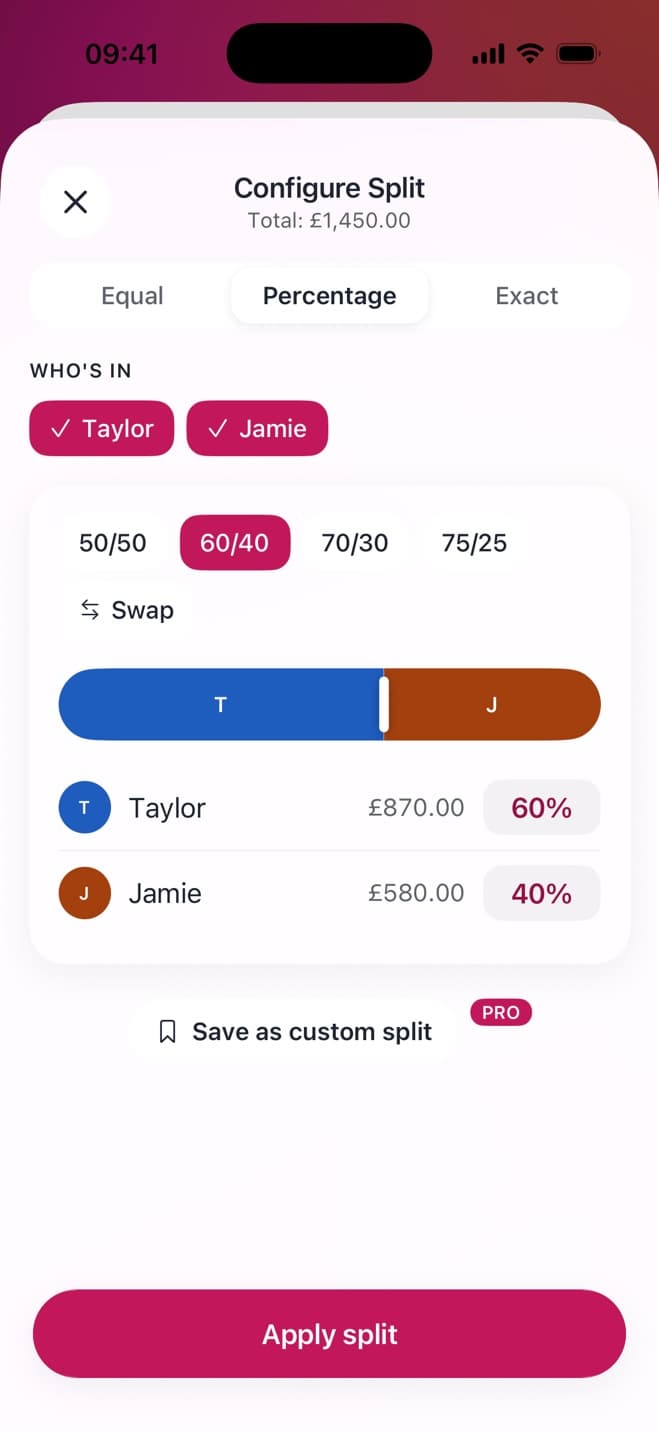
Taylor takes home $5,400 a month and Jamie takes home $3,600: $9,000 between them. Their shared costs are rent ($2,000), utilities and internet ($250) and groceries ($600): $2,850 a month.
Split 50/50, each pays $1,425. Split by income, Taylor pays 60% (5,400 ÷ 9,000) and Jamie pays 40%.
| 50/50: Taylor | 50/50: Jamie | 60/40: Taylor | 60/40: Jamie | |
|---|---|---|---|---|
| Rent ($2,000) | $1,000 | $1,000 | $1,200 | $800 |
| Utilities and internet ($250) | $125 | $125 | $150 | $100 |
| Groceries ($600) | $300 | $300 | $360 | $240 |
| Each pays | $1,425 | $1,425 | $1,710 | $1,140 |
| Left from take-home pay | $3,975 | $2,175 | $3,690 | $2,460 |
Neither is wrong. 50/50 is simple and feels equal when you earn about the same. Splitting by income feels fairer when you don't, because you each give up the same share of what you earn. Many couples land somewhere in between: rent by income, everything else equally. Whatever you pick, agree what counts as income (we used take-home pay), and when you'll look at it again if one of you changes jobs. For all four options, including a joint account and combining everything, see how to split finances as a couple.
If you're moving in with roommates rather than a partner, the same thinking applies but the methods differ: see how to split bills with roommates.
Questions about chores and the house
"We'll both just do stuff" lasts about two weeks. The usual result is that the person who notices the mess first ends up doing it, and starts to resent it. Be specific.
- 1What does "clean" mean to each of us? Dishes done tonight, or by the weekend?
- 2Which chores does each of us hate, and which don't we mind?
- 3Do we split chores by preference, take turns, or rotate everything weekly?
- 4Who cooks, and who cleans up after?
- 5Who does the grocery shopping, and how do we keep a shared list?
- 6What about the jobs nobody sees: paying bills, booking repairs, remembering birthdays, restocking toilet paper?
- 7Would we pay for a cleaner, and how would we split it?
If you'd like a structure, our chore chart for adults shows how to weight chores by effort so the split is fair, including the invisible jobs couples tend to forget.
Questions about space, routines and guests
- 1What time do we each go to bed and get up? Who needs quiet in the morning?
- 2How much alone time does each of us need, and how will we ask for it without it feeling like rejection?
- 3Does either of us work from home? Where?
- 4Which furniture and things are we keeping, and which go? Who decides how the place looks?
- 5How often are friends welcome, and how much notice do we give each other?
- 6How long can family stay, and how often?
- 7Pets: whose are they, who walks and feeds them, and who pays the vet?
- 8Smoking, drinking, music, TV in the bedroom: any dealbreakers?
Questions about the practical stuff
- 1Are we moving into one of our places, or somewhere new to both of us?
- 2If it's one of our places, how do we make it feel like it's both of ours?
- 3Who's on the lease? If only one of us, does the landlord know and allow it?
- 4What happens if one of us loses a job or can't pay their share for a month?
If it doesn't work out
Nobody wants to talk about this while they're picking out a couch. But you'll never be kinder to each other about it than you are now, so agree the basics while you're happy.
- 1Who would stay, and who would move out?
- 2How much notice would we give each other, and who would cover the rent in the meantime?
- 3How would we split the things we bought together?
- 4How would we settle any money one of us owes the other?
Write the answers down. If you want the money and house rules in a more formal shape, the sections in our roommate agreement template (rent, bills, chores, guests, moving out) work just as well for couples.
Printable moving in together checklist
Moving in together checklist
Print it, go through it together, and tick each line once you've agreed it.
Talk it through
- We've each said what moving in means to us
- We've talked about where we see ourselves in a few years
- We know how each of us handles stress and arguments
Money
- We've listed every shared cost: rent, utilities, internet, groceries, subscriptions, supplies
- We've agreed how each one is split: 50/50, by income, or a mix
- We've decided on a joint account, separate money, or both
- We've talked about any debt either of us has
- We've decided whose name goes on the lease and on each account
- We've picked how we track shared spending and a day each month to settle up
The house
- We've agreed who does which chores, and how often
- We've agreed who cooks, who shops and how we keep the grocery list
- We've agreed how often guests and family can stay
- We've talked about alone time, sleep schedules and working from home
- We've decided what furniture we're keeping
Moving day and after
- The landlord has approved both of us living there
- Utilities and internet are set up or transferred, with the move-in date
- Mail and addresses are updated for both of us
- Renter's insurance covers both of us and our things
- We've set a date, about a month in, to check in on how it's going
After you move in: the first-month check-in
Put a date in the calendar about four weeks after moving day. Keep it short and low-stakes: what's working, what's annoying, and whether the money split still feels fair now you've seen the real bills. Small fixes now stop small irritations from turning into the thing you argue about every week. For a week-by-week plan from moving day to that check-in, see our moving in together tips.
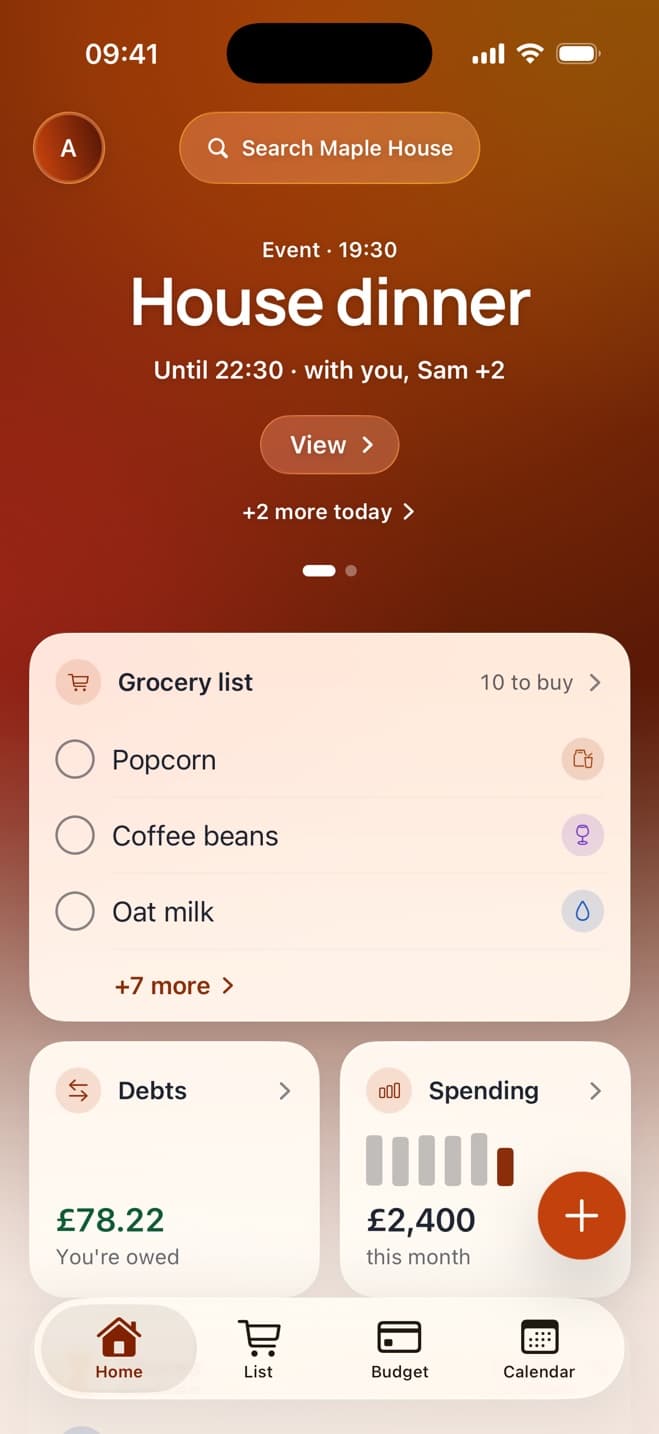
This is where an app earns its keep. House Plan is the app we built for sharing a home, and it's free for two:
- Shared bills and expenses, split equally, by percentage or by exact amounts, with who owes whom always visible
- Recurring bills for rent and utilities that add themselves every month
- Monthly spending by category, so the check-in is about numbers, not memories
- Chores that rotate on their own, with points and a monthly leaderboard
- One grocery list and a shared calendar for trash day, the in-laws and the check-in itself
To be upfront about the limits: Free covers 2 people with 2 recurring bills and 4 active chores. Pro adds unlimited recurring bills and saved splits like your 60/40. Pro's first month is free. House Plan is on iPhone; Android is coming soon.
See what House Plan does for couples.