Chores
Roommate chore chart: a fair, rotating template for 2, 3 or 4 roommates
A roommate chore chart works when the chores are weighted by effort, grouped into zones of equal work, and rotated every week, so nobody gets the bathroom forever. Below are ready-made rotations for 2, 3 and 4 roommates.
By Jack JonesPublished 10 min read
The short version
- Group the chores into zones (kitchen, bathroom, living areas, trash and supplies) and give each zone the same amount of work.
- Weight chores by effort with points (1 for quick jobs, 3 for the gross ones), so “one chore each” doesn't mean the bathroom versus the recycling.
- Rotate weekly. Everyone does every zone once a month, and nobody owns the worst job.
- Keep dishes off the chart: make it a house rule (your own dishes, same day) instead.
- Agree what “done” means for each zone before the first week, and put it on the chart.
Why most roommate chore charts fail
Most chore charts start with good intentions and a whiteboard, and are ignored by week three. It's rarely laziness. The chart usually breaks in one of three ways:
- It isn't fair. “Everyone picks one chore” gives one person the bathroom and another the recycling. The person with the bathroom notices.
- It never changes. Fixed jobs feel fine for a month, then the person stuck with the worst one starts quietly skipping it.
- Nobody agreed what “clean” means. One roommate's wiped counter is another's crime scene, and the argument is about standards, not effort.
The chart below fixes all three: chores weighted by effort, grouped into zones of equal work, rotated weekly, with a written definition of done for each zone.
What to put on a roommate chore chart
Start by listing every shared chore and how often it really needs doing. Your own bedroom isn't on the chart; anything in shared space is. Here's a typical list for an apartment with one shared bathroom, with a simple effort score:
| Chore | How often | Points |
|---|---|---|
| Wipe counters, stovetop and microwave | Weekly (plus a wipe after cooking) | 2 |
| Sweep and mop the kitchen floor | Weekly | 2 |
| Clear out old food and wipe the fridge shelves | Weekly | 2 |
| Clean the toilet, sink and mirror | Weekly | 3 |
| Scrub the shower or tub | Weekly | 2 |
| Empty the bathroom trash and restock toilet paper | Weekly | 1 |
| Vacuum the living room and hallway | Weekly | 2 |
| Mop hard floors in shared areas | Weekly | 2 |
| Dust and tidy shared surfaces | Weekly | 1 |
| Water the plants, shake out the rugs | Weekly | 1 |
| Take out trash and recycling on trash day | Weekly | 2 |
| Wipe out the kitchen trash can | Weekly | 1 |
| Restock shared supplies (dish soap, sponges, paper towels) | Weekly | 1 |
| The shared-supplies run | Weekly | 2 |
Who buys the toilet paper is half chore, half money. If the supplies run is on the chart, agree how those purchases are split too; our guide on how to split bills with roommates covers shared supplies.
How to split chores with roommates fairly
Fair doesn't mean everyone does the same number of chores. It means everyone does the same amount of work over a month. Two ideas get you there.
Group chores into zones of equal work
Instead of fourteen separate jobs, bundle them into zones that each add up to the same points. With the list above, four zones of 6 points each work neatly:
| Zone | Chores | Points |
|---|---|---|
| Kitchen | Counters, stovetop and microwave (2) · kitchen floor (2) · fridge clear-out (2) | 6 |
| Bathroom | Toilet, sink and mirror (3) · shower or tub (2) · bathroom trash and toilet paper (1) | 6 |
| Living areas | Vacuum (2) · mop hard floors (2) · dust and tidy (1) · plants and rugs (1) | 6 |
| Trash and supplies | Trash and recycling out (2) · wipe the trash can (1) · restock supplies (1) · supplies run (2) | 6 |
| Total | 14 chores | 24 |
Zones are easier to remember than lists (“I've got the bathroom this week”), and they make it obvious who's responsible when something's left undone.
Rotate, don't assign
Fixed jobs only work if someone genuinely likes a chore (some people really do enjoy vacuuming). Otherwise, rotate. A weekly rotation means everyone does every zone once a month, nobody is stuck with the shower, and you each learn what “clean” takes in every room.
| Method | How it works | Good for | Watch out for |
|---|---|---|---|
| Weekly rotation | Zones move one person along every week | Most apartments | Someone away for a week: swap, don't skip |
| Fixed jobs | Everyone keeps the same zone | Roommates who prefer certain chores | Resentment if the zones aren't equal |
| Chore wheel | A wheel is turned each week to move the zones on | Making the rotation visible on the fridge | A random spin isn't fair; turn it one notch instead |
| Points tally | Everyone picks chores until they reach the week's points | Flexible schedules | Needs someone to keep score |
Rotating chore chart templates for 2, 3 and 4 roommates
Copy the one that matches your apartment. Each zone is the same amount of work, and each row is one week. When you reach the last week, start again from the top.
4 roommates: four zones, a four-week rotation
| Week | Kitchen | Bathroom | Living areas | Trash and supplies |
|---|---|---|---|---|
| Week 1 | Alex | Sam | Jordan | Priya |
| Week 2 | Priya | Alex | Sam | Jordan |
| Week 3 | Jordan | Priya | Alex | Sam |
| Week 4 | Sam | Jordan | Priya | Alex |
3 roommates: three zones, a three-week rotation
With three people, fold the trash and supplies jobs into the other zones so each still adds up to the same work:
- Kitchen and trash: the kitchen zone (6) plus trash and recycling out (2) = 8 points
- Bathroom and restocking: the bathroom zone (6) plus wiping the trash can (1) and restocking supplies (1) = 8 points
- Living areas and the supplies run: the living areas zone (6) plus the supplies run (2) = 8 points
| Week | Kitchen and trash | Bathroom and restocking | Living areas and supplies run |
|---|---|---|---|
| Week 1 | Alex | Sam | Jordan |
| Week 2 | Jordan | Alex | Sam |
| Week 3 | Sam | Jordan | Alex |
2 roommates: two halves, swapped every week
- Kitchen and trash: the kitchen zone (6) plus the whole trash and supplies zone (6) = 12 points
- Bathroom and living areas: the bathroom zone (6) plus the living areas zone (6) = 12 points
| Week | Kitchen and trash | Bathroom and living areas |
|---|---|---|
| Week 1 | Alex | Sam |
| Week 2 | Sam | Alex |
Agree what “done” means
Most chore fights are really about standards. Spend ten minutes in your first house meeting agreeing a short definition of done for each zone, and write it on the chart. Then nobody has to argue about whether the bathroom “counts”; it either matches the list or it doesn't.
Agree a deadline too. “By Sunday night” works for most apartments: it gives everyone the weekend, and the week starts clean. If trash day is midweek, that one job has its own day.
Printable roommate chore chart: what “done” means
Print it, write the names for this week next to each zone, and stick it on the fridge.
Kitchen (6 points) · done by Sunday night
- Counters, stovetop and the inside of the microwave wiped
- Kitchen floor swept and mopped
- Old food thrown out and fridge shelves wiped
Bathroom (6 points) · done by Sunday night
- Toilet cleaned inside and out, sink and mirror wiped
- Shower or tub scrubbed, drain cleared
- Bathroom trash emptied and a spare toilet paper roll out
Living areas (6 points) · done by Sunday night
- Living room and hallway vacuumed
- Hard floors mopped
- Shared surfaces dusted and cleared of everyone's stuff
- Plants watered, rugs shaken out
Trash and supplies (6 points) · trash on trash day
- Trash and recycling out on trash day, bins back in
- Kitchen trash can wiped out
- Dish soap, sponges, paper towels and toilet paper checked and restocked
- Shared-supplies run done, and the receipt shared
House rules (everyone, every day)
- Wash your own dishes the same day
- Empty the dishwasher if you find it clean
- Away for a week? Swap your zone with someone before you go
What to say when a roommate skips their chores
It will happen. The chart makes the conversation easier, because it's about the chart, not about anyone's character. Keep it short, specific and early.
The first missed week
Assume it's a busy week, not a statement. A quick, light message the morning after the deadline: “Hey, the bathroom's still on you from last week. Can you get to it tonight?” Most people just do it.
When it becomes a pattern
Raise it in person, and about the system rather than the person: “The bathroom's been skipped three weeks out of the last five. Is the rotation not working for you? Would you rather swap to a different zone, or a different day?” Sometimes the fix is genuinely a different deadline, or giving someone the zone they don't mind.
Agree a make-up rule in advance
The easiest time to agree the consequence is before anyone needs it. A common one: miss your zone, and you do it next week as well as your new one. Fair, a little annoying and easy to enforce, because everyone signed up to it in week one.
A paper chart, a spreadsheet or an app?
A printed chart on the fridge is the right start: it's visible, free and everyone can see whose week it is. Where it struggles is the admin: writing out next month's names, remembering whose turn it was after someone swapped, and knowing who's actually been doing their share.
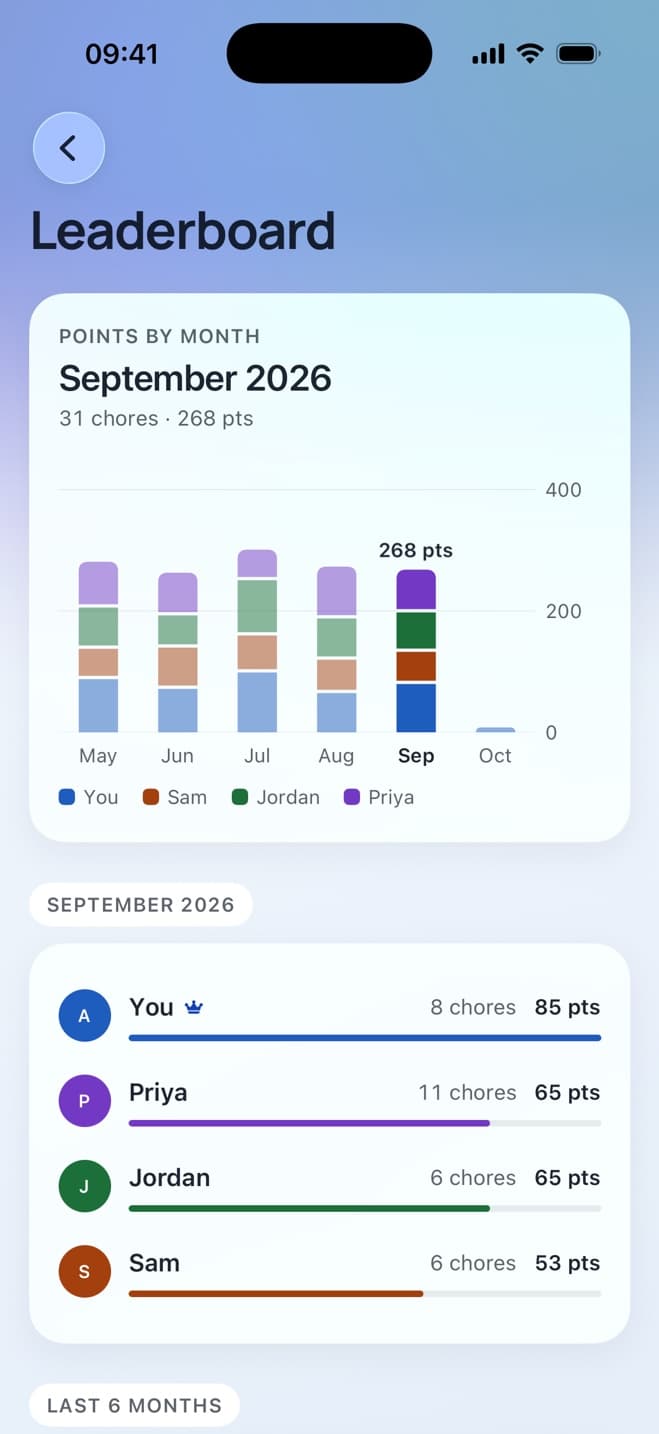
That's the part House Plan takes off your hands. Chores have a name and a day on them and rotate through the apartment by themselves. Each finished chore earns points, and a monthly leaderboard shows who's been carrying the house, so nobody has to be the one who keeps score.
To be upfront about the limits: Free covers 2 people and 4 active chores, so it suits two roommates with one chore per zone. A house of three or more needs Pro, which covers up to 6 roommates and 20 active chores for $34.99 a year for the whole apartment. Your first month of Pro is free. The same app also splits the bills and keeps one grocery list. House Plan is on iPhone; Android is coming soon.
More for sharing an apartment: how to split bills with roommates, and everything House Plan does for roommates.