Money
How to split finances as a couple: 4 ways, with real numbers
Couples split finances in one of four ways: 50/50, in proportion to income, a joint account for shared bills with separate money for the rest, or everything joint. The right one depends on how close your incomes are and how much you want to combine.
By Jack JonesPublished 10 min read
The short version
- 50/50 is simplest and works when you earn about the same.
- By income (for example two-thirds/one-third) means you each spend the same share of your pay on the home.
- Yours, mine and ours is the most common middle ground: a joint account or shared tab for the bills, separate money for everything else.
- All joint suits couples who think of their money as one pot, usually married or long-term.
- Whatever you pick, list the shared costs, agree who pays which, track it in one place and check it every few months.
How to split finances as a couple: the short answer
There's no fair split that works for every couple, but there is a fair way to choose one. Agree which costs are shared, pick a method for splitting them that you both think is fair, and decide where the money for them comes from. Most couples end up using one of four systems:
| Method | How it works | Best for |
|---|---|---|
| 50/50 | Every shared cost is split equally | Incomes within a few thousand a year of each other |
| By income | Each pays the same percentage of their pay | One of you earns noticeably more |
| Yours, mine and ours | Shared bills from a joint pot, the rest separate | Couples who want shared bills without merging everything |
| All joint | All income goes into one pot | Married or long-term couples with shared goals |
The rest of this guide works through all four with the same couple's real numbers, so you can see what each one means for your pay, then covers joint versus separate accounts, the conversation itself and what to do when things change.
The four ways to split finances
1. Split everything 50/50
Every shared cost (rent, utilities, groceries, the streaming services you both use) is split down the middle. It's easy to explain, easy to track and feels fair when you earn about the same.
Watch out for: a big income gap. If one of you earns twice what the other does, 50/50 means the lower earner spends twice the share of their pay on the home, and often can't afford the restaurants and trips the other suggests. That gap tends to show up as resentment rather than a conversation.
2. Split in proportion to income
Add up what you both earn, work out each person's share of the total, and split shared costs by those percentages. If you earn $6,000 a month and your partner earns $3,000, you earn two-thirds of the total, so you pay two-thirds of the shared bills. You each spend the same share of your pay on the home.
Watch out for: deciding what counts as income. Take-home pay is the simplest and fairest for most couples, because it's what you actually have to spend. Agree whether bonuses and side income count, and redo the math when either of you changes jobs.
3. Yours, mine and ours
Shared costs come from a shared pot, and everything else stays separate. The pot can be a joint checking account you each pay into every month, or simply a shared tab where you track who paid for what and settle up. How much each of you puts in can be 50/50 or by income.
This is the middle ground many couples land on: you're a team on the home, but nobody has to justify a new pair of sneakers. Watch out for: gray areas. Decide up front whether dinners out, vacations, gifts for each other's families and a car one of you mostly drives come from the shared pot or your own money.
4. Combine everything
Both paychecks go into one account and every cost comes out of it. There's nothing to split and nothing to settle, and it fits couples who already think of "our money" rather than "mine and yours", often after marriage or children.
Watch out for: spending styles. If one of you is a saver and the other a spender, a single pot turns every purchase into a joint decision. Many couples who combine everything still give each person the same monthly amount of personal "no questions asked" money.
A worked example: the same couple, four ways
Morgan takes home $6,000 a month and Riley takes home $3,000: $9,000 between them. Their shared costs are rent ($2,100), utilities and internet ($240) and groceries ($660): $3,000 a month.
| Method | Morgan pays | Riley pays | Morgan has left | Riley has left |
|---|---|---|---|---|
| 50/50 | $1,500 (25%) | $1,500 (50%) | $4,500 | $1,500 |
| By income (2/3 and 1/3) | $2,000 (33.3%) | $1,000 (33.3%) | $4,000 | $2,000 |
| Rent by income, the rest 50/50 | $1,850 (30.8%) | $1,150 (38.3%) | $4,150 | $1,850 |
| All joint, leftover shared equally | $3,000 (50%) | $0 (0%) | $3,000 | $3,000 |
Look at the right-hand columns. Split 50/50, Riley spends half of everything they earn on the home and has $1,500 left, against Morgan's $4,500. Split by income, they each spend a third. Combining everything closes the gap entirely, but only if Morgan genuinely thinks of the money as shared.
None of these is the right answer. It's the right answer if you both look at the table and think it's fair. If you're still deciding, the middle row (rent by income, everything else 50/50) is a common compromise: rent is the big cost, so splitting it by income does most of the work.
Joint account vs separate finances
The method decides who pays how much. The accounts decide where the money sits. You can split by income with separate accounts, or 50/50 with a joint one. Here's how the three setups compare:
| Separate accounts | Joint account for bills | Everything joint | |
|---|---|---|---|
| How bills get paid | Whoever's name is on the bill pays, and you settle up | You each transfer your share in; bills come out of it | Everything comes out of one account |
| Tracking needed | Every shared expense | Just the monthly transfers | None between you |
| Independence | Full | High | Low, unless you add personal money |
| Works well when | You're new to living together | You want shared bills without merging | You share every goal |
| Watch out for | Losing track of who's owed what | Topping it up when a bill is bigger than usual | Different spending styles |
How to split bills with your partner, step by step
- 1List every shared cost. Rent or mortgage, electric, gas, water, internet, renter's insurance, groceries, household supplies, subscriptions you both use, pet costs.
- 2Decide what's not shared. Usually your own phone, car, debt payments, clothes and hobbies. Dinners out and vacations are the ones to talk about.
- 3Pick a method for each cost. One method for everything is simplest, but "rent by income, the rest 50/50" is fine too.
- 4Decide who pays each bill. Whoever's name is on the account usually pays it, then the other person pays back their share.
- 5Track it in one place. A shared app or spreadsheet, not two memories.
- 6Settle up on the same day every month. The day after rent goes out works well.
- 7Check the split every six months, and whenever either of your incomes changes.
Splitting with roommates instead of a partner? The methods are different (room size and usage matter more than income): see how to split bills with roommates.
How to have the money conversation
Most couples don't fall out over the split. They fall out because one of them assumed something the other never agreed to. A few ways to start the conversation without it feeling like a negotiation:
- To open it: "Before we sign the lease, can we work out how we'll split the bills? I'd rather agree it now than guess."
- If you earn more: "I don't think 50/50 is fair when I earn more. Would splitting by income feel better to you?"
- If you earn less: "I want to pay my way, but half the rent is a lot of my pay. Could we look at splitting the rent by income?"
- If you want to keep some money separate: "I'm happy to share all the house costs. I'd like to keep my own account for the rest, and I don't mind if you do the same."
- To close it: "Let's try this for three months and see how it feels."
Have it before you move in if you can. Our questions to ask before moving in together include the money questions worth asking alongside this one, and our tips for moving in together show how to split the moving costs themselves.
When things change
A split that was fair last year can stop being fair after a new job, a layoff or a baby. Agree now that you'll revisit it, so asking later doesn't feel like an accusation.
- One of you gets a raise or a new job: redo the income percentages with the new take-home pay.
- One of you loses a job or goes back to school: agree a temporary split, and a date to look at it again.
- One of you takes on more unpaid work at home (looking after a baby, a long renovation): many couples move toward combining more, so the person earning less isn't left with nothing for themselves.
- You get married: marriage can change things like taxes and who owns what, so it's worth reviewing your setup and talking to a financial professional if you have questions.
Printable couple finances checklist
Couple finances checklist
Go through it together and tick each line once you've agreed it.
What's shared
- We've listed every shared cost and roughly what it is each month
- We've agreed what isn't shared (our own phones, cars, debt, hobbies)
- We've agreed whether dinners out, vacations and gifts are shared
How we split it
- We've picked a method: 50/50, by income, or a mix
- If by income, we've agreed what counts as income (take-home pay or before tax)
- We've written down each person's share of each bill
Where the money goes
- We've decided on separate accounts, a joint account for bills, or everything joint
- We know who pays each bill and whose name is on each account
- We've picked one place to track shared spending
- We've set a day each month to settle up
Keeping it fair
- We've agreed how much either of us can spend on the home without checking first
- We've set a date in six months to look at the split again
Keep track without keeping score
Whichever method you pick, the hard part is keeping track month after month without one of you becoming the household accountant. House Plan is the app we built for sharing a home, and it's free for two:
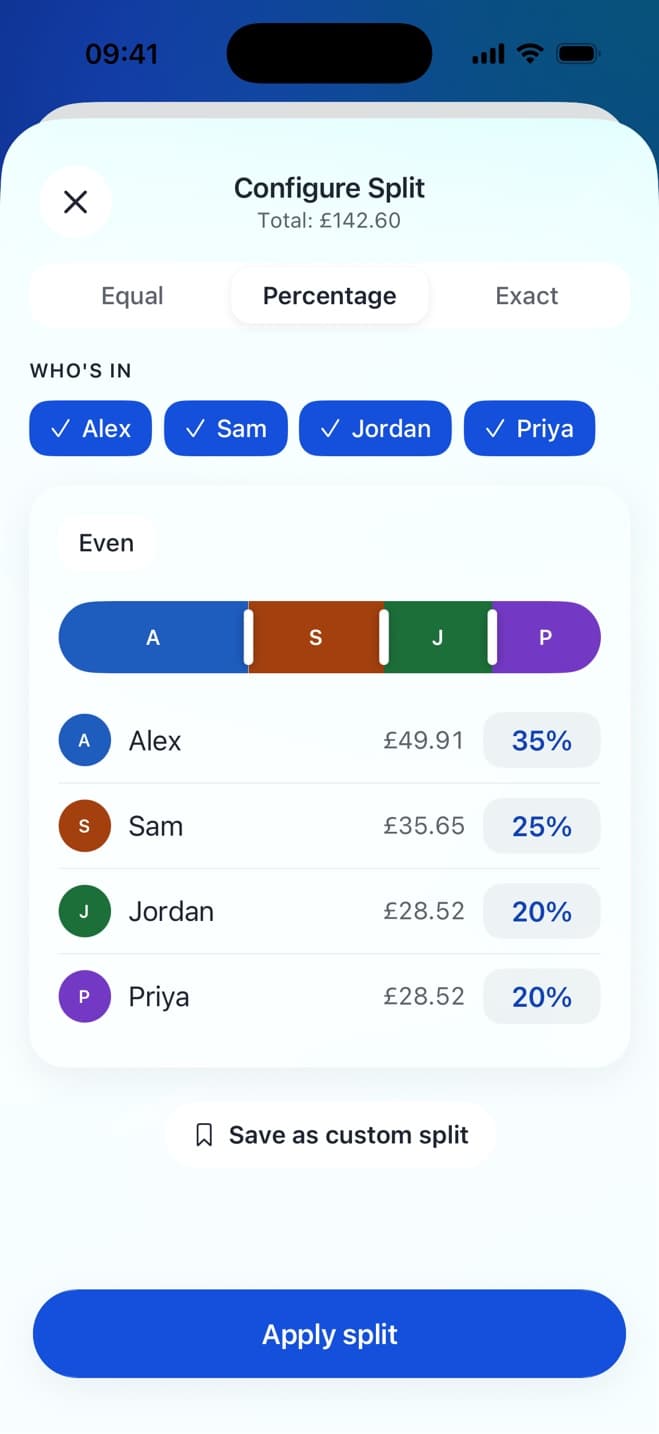
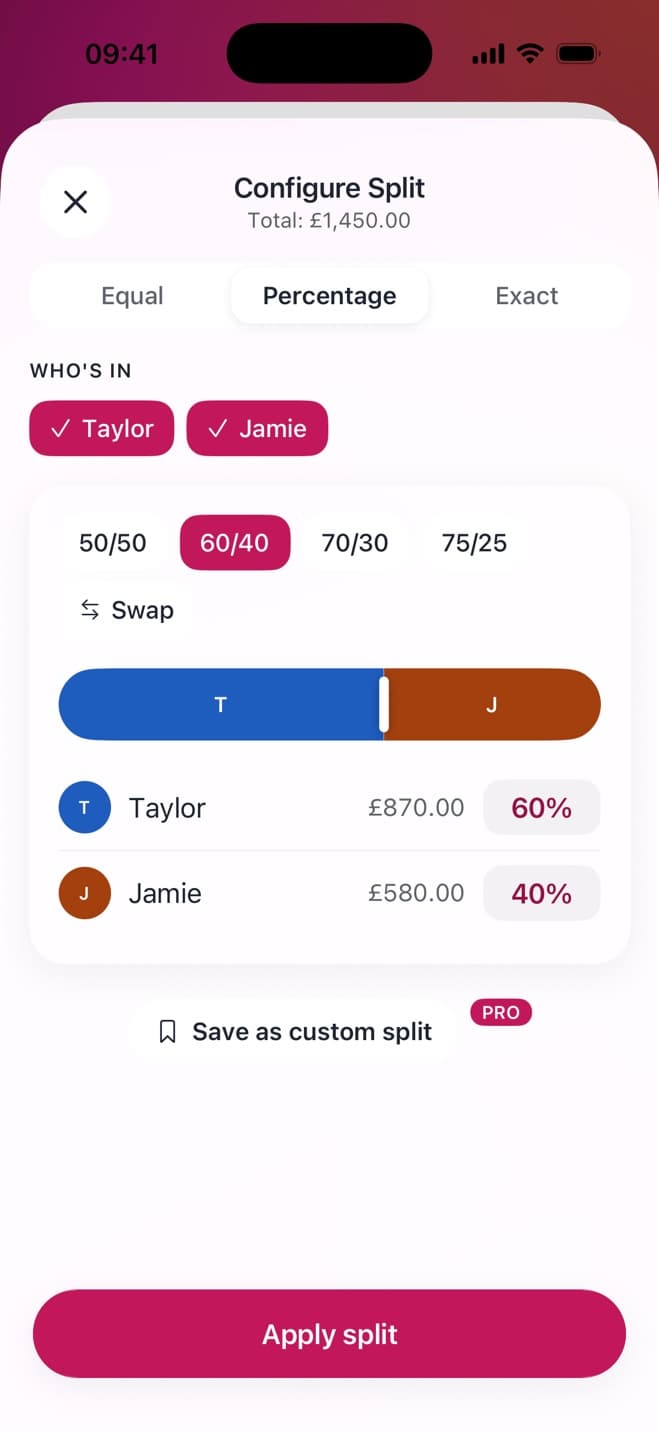
- Shared expenses, split equally, by percentage or by exact amounts, with who owes whom always visible
- Recurring bills for rent and utilities that add themselves every month
- Settle up with a tap, so the balance clears for you both
- Monthly spending by category, so your six-month check-in starts with real numbers
- Chores, a shared grocery list and a calendar, in the same app
To be upfront about the limits: Free covers 2 people with 2 recurring bills. Pro adds unlimited recurring bills and saved splits, so a by-income split becomes your default. Pro's first month is free. House Plan is on iPhone; Android is coming soon.
See what else House Plan does for couples.