Living together
Moving in together tips: a plan for the first 30 days
The best moving in together tips are about the first month, not the move: decide what stays before the boxes arrive, split the moving costs on paper, set up bills, chores, groceries and a calendar in week one, protect some time apart, and check in after four weeks.
By Jack JonesPublished 12 min read
The short version
- Before the move, decide what stays and what goes, room by room. Duplicates are easy; the couch is the hard one.
- Split the moving costs like any other bill: shared things 50/50 (or by income), your own move-out costs on you. Settle the difference once.
- In week one, set up four shared systems: bills, chores, the grocery list and a house calendar. Most first fights are about one of them.
- Keep some space and some friends. Living together doesn't mean doing everything together.
- Check in after a month, and know the difference between normal adjustment and a real red flag.
Moving in together tips: the 30-day plan at a glance
Most advice about moving in together is either about packing boxes or about your feelings. The part that actually decides how it goes sits in between: the first few weeks, when two sets of habits, two sets of stuff and two ways of handling money land in one apartment at once.
If you haven't had the big conversations yet (why you're moving in, how you'll split rent, whose name goes on the lease), start with our questions to ask before moving in together. This guide picks up from there: what to do, week by week, once you've said yes.
| When | The job | Done when |
|---|---|---|
| Before the move | Decide what stays, and split the moving costs | Every room has a plan, and you've agreed who pays for what |
| Week 1 | Set up bills, chores, groceries and the calendar | Rent, utilities and chores have a name and a day on them |
| Week 2 | Protect your own space and time | You each have a corner, an evening and your friends |
| Week 3 | Have your first real disagreement well | You've fixed one small annoyance without it becoming a fight |
| Week 4 | The first-month check-in | You've changed at least one thing that wasn't working |
Before the move: decide what stays
Two people usually means two of everything: two toasters, two shower curtains, two opinions about the couch. Decide before moving day, while it's still a list and not a hallway full of boxes. Go room by room and sort every bigger item into keep, sell, donate or store.
| What it is | A rule that works | Why |
|---|---|---|
| Duplicates (toasters, pans, lamps) | Keep the better one; sell or donate the other | Nobody needs two, and it's not personal |
| Big furniture (couch, bed, table) | Keep what fits the new place, even if it's not yours | Measure first: the apartment decides, not the owner |
| Things one of you loves | Each of you gets a few vetoes | A short list of non-negotiables beats arguing about everything |
| Things neither of you loves | Replace them together, later | Buying something new together makes it feel like your place |
| Sentimental things | Keep them, and find them a place | Storage is fine; throwing out someone's history isn't |
If one of you is moving into the other's place, the person already there has the extra job. Clear half the closet and some shelves before the move, not after, and let the newcomer change something visible: the art, the couch, the bedroom layout. Otherwise it stays "your place" for a long time.
How to split the costs of moving in together
Moving costs money before the first rent payment: a truck, boxes, maybe movers, and usually a few new things for the new place. The simplest fair rule: things for the shared home are shared; costs of leaving your old place are yours. Split the shared ones the same way you'll split rent (50/50 or by income), and settle the difference once.
Here's how that works for Alex and Sam, who split shared costs 50/50. Alex paid for the truck, the boxes and the movers. Sam paid for a new bed frame and a cleaner for their old apartment. Alex is also paying a last month on a storage unit.
| Cost | Paid by | Shared? | Alex's share | Sam's share |
|---|---|---|---|---|
| Truck rental ($180) | Alex | Yes | $90 | $90 |
| Boxes and tape ($60) | Alex | Yes | $30 | $30 |
| Movers, 2 hours ($320) | Alex | Yes | $160 | $160 |
| New bed frame ($440) | Sam | Yes | $220 | $220 |
| Cleaning Sam's old apartment ($150) | Sam | No, Sam's | $0 | $150 |
| Alex's storage unit, last month ($90) | Alex | No, Alex's | $90 | $0 |
| Total | $590 | $650 |
Two things make this easy. Write each cost down the day you pay it, with who paid, and agree what counts as shared before anyone buys anything big. If your incomes are very different, the same table works with a 60/40 split instead of 50/50: see how to split finances as a couple for how to work out the percentages.
Week 1: set up the four shared systems
Most early fights about living together aren't really about the relationship. They're about a bill nobody paid, dishes nobody did, milk nobody bought or a visit nobody mentioned. Set up four simple systems in the first week, while you're both still in a good mood about the place.
| System | Set it up like this | What happens without it |
|---|---|---|
| Bills | List rent, electric, gas, internet and streaming, with the due date, whose account it's on and how it's split | One of you quietly pays more, and notices it in month three |
| Chores | Split the jobs into a few areas with a name on each, and swap every week or month | Whoever notices the mess first ends up doing it, and resents it |
| Groceries | One shared list you both add to when something runs out | Two jars of peanut butter and no toilet paper |
| Calendar | Trash day, rent day, visitors, trips and the first-month check-in | "You didn't tell me your mom was coming" |
For chores, don't start from a list of 30 jobs. Start with four areas (kitchen, bathroom, floors and trash, shopping and errands), give each a name, and swap regularly. Our chore chart for adults shows how to weight the jobs so the split is fair, including the invisible ones like booking repairs and remembering birthdays.
For bills, put the utilities in the move-in week, not the week the first bill arrives. Agree whose name each account is in, and split them the way you agreed for rent. If you want the full menu of options (50/50, by income, a joint account, or a mix), they're all worked through in how to split finances as a couple.
Week 2: protect your own space and time
The first weeks of living together can feel like a long sleepover, and that's fun until one of you needs an evening alone and the other takes it personally. Plan for it now, while nobody needs it yet.
- Give each of you a corner. A desk, a chair, a shelf: somewhere that's yours, even in a studio.
- Keep one evening a week each for friends, a class or just being alone. Put it in the calendar so it's a plan, not a rejection.
- Keep your friends. Seeing them without your partner is normal, and good for both of you.
- Agree a signal for "I need a bit of quiet" that doesn't need explaining. Headphones on, door half closed, whatever works.
- Talk about sleep and mornings. Who gets up first, alarms, lights, the bathroom queue.
Try saying it like this: "I love living with you. I also need Thursday evenings to myself, and it's not about you. Can we put it in the calendar?"
Week 3: your first real disagreement (and how to have it)
Somewhere around week three the novelty wears off and the small things start to show: the towel on the floor, the thermostat, the friend who stays too late. That's normal. What matters is fixing small things while they're small.
- 1Raise it within a day or two, not after a month of sighing.
- 2Talk about the thing, not the person. "The dishes have been in the sink since Sunday" works. "You never clean up" doesn't.
- 3Say what you'd like instead, specifically: "Can we do dishes before bed?"
- 4Agree a small change and a time to look at it again. Most house problems are fixed by a rule, not a promise to try harder.
| The argument | Instead of | Try |
|---|---|---|
| Chores | "I always end up doing everything." | "Can we write down who does what for a month, and see if it feels even?" |
| Money | "You owe me for like half the groceries." | "Let's log the shared stuff in one place, so neither of us has to keep track in our heads." |
| Guests | "Your friends are always here." | "Can we agree how many nights a week is OK, and give each other a day's notice?" |
If you share the place with roommates as well as a partner, the same rules apply, just written down more formally: see our roommate agreement template.
Week 4: the first-month check-in
Put it in the calendar for about four weeks after moving day. Keep it short (20 minutes, over dinner is fine) and go through the same five questions:
- 1What's working better than we expected?
- 2What's one thing that's been bugging each of us?
- 3Now we've seen the real bills, does the money split still feel fair?
- 4Does the chore split still feel even?
- 5Are we each getting enough time alone and with friends?
End with one change each, and a date for the next check-in. After that, every few months is plenty, or whenever something big changes, like a new job.
Normal adjustment, or a red flag after moving in together?
Some friction in the first months is completely normal: you're learning how someone lives, not just how they date. A few patterns are different, and worth taking seriously rather than putting down to adjustment.
| Usually normal adjustment | Worth taking seriously |
|---|---|
| Bickering about dishes, towels and the thermostat | One of you refuses to do any share of the housework at all |
| Needing more time alone than you expected | Being discouraged or stopped from seeing friends and family |
| Different ideas about how tidy is tidy enough | Constant criticism, name-calling or contempt |
| Some awkwardness about money while you find a system | Hidden debt, pressure to hand over money, or one of you controlling what the other spends |
| Missing your own space | Checking your phone, or needing to know where you are all the time |
| An argument that ends with an apology and a fix | Feeling afraid of how your partner will react |
Printable first 30 days checklist
First 30 days of living together
Stick it on the fridge and tick things off as you go.
Before the move
- We've gone room by room and decided what stays, goes or gets stored
- We've measured the big furniture against the new place
- We've agreed which moving costs are shared and how we split them
- We've agreed who keeps anything we buy together
- The person already living there has cleared space for the other
Week 1
- Every bill is listed with its due date, account holder and split
- Chores are split into areas, each with a name on it
- We have one shared grocery list
- Trash day, rent day and the first-month check-in are on a shared calendar
- Moving costs are settled up
Weeks 2 and 3
- We each have a corner of the place that's ours
- We each have a regular evening for friends or time alone
- We've agreed how often guests can stay, and how much notice to give
- We've fixed one small annoyance with a rule, not a row
Week 4
- We've had the first-month check-in
- We've each picked one thing to change
- The next check-in is on the calendar
An app for the boring parts
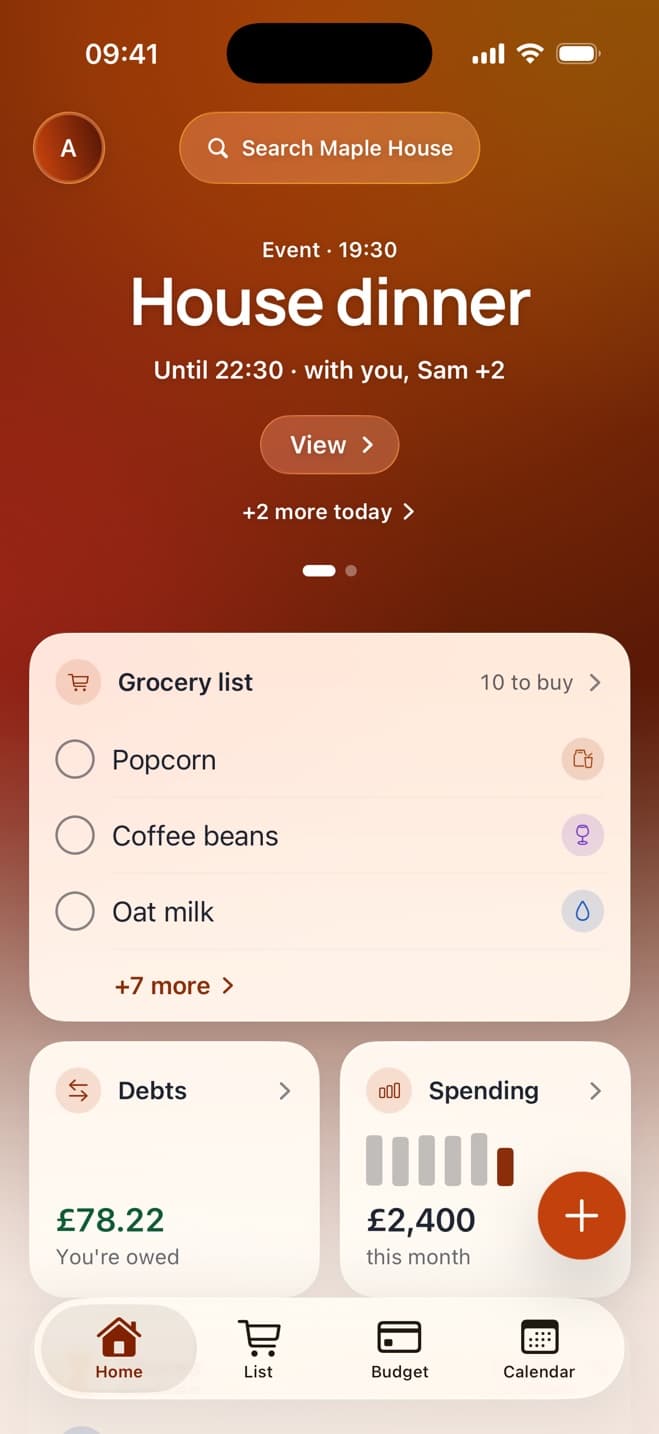
None of this needs an app: a shared note and a paper calendar will do. But the four week-one systems are exactly what House Plan is built for, and it's free for two:
- Shared expenses for the moving costs and everything after, split equally, by percentage or by exact amounts, with who owes whom always visible
- Recurring bills for rent and utilities that add themselves every month
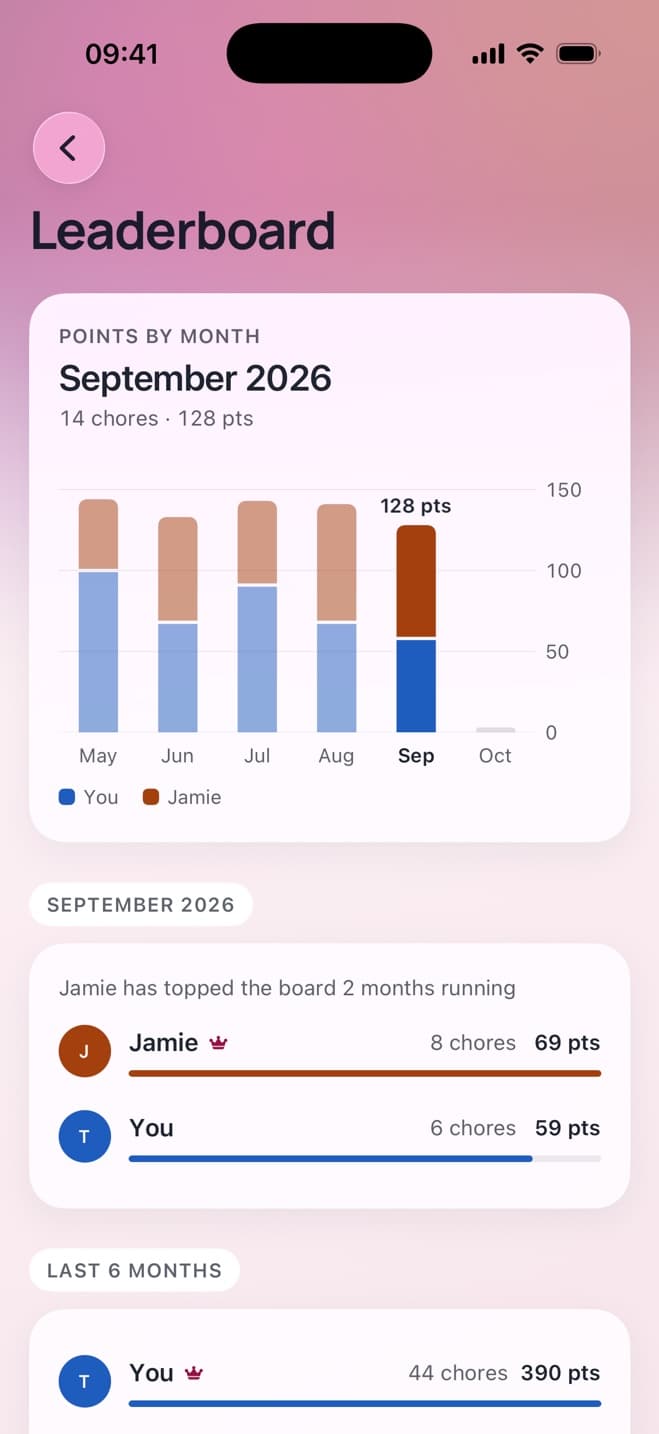
- Chores that rotate on their own, with points and a monthly leaderboard
- One grocery list you both add to, grouped by aisle
- A shared calendar for trash day, visitors and the first-month check-in
To be upfront about the limits: Free covers 2 people with 2 recurring bills, 4 active chores and 20 grocery items. Pro adds unlimited recurring bills and saved splits, like a 60/40. Pro's first month is free. House Plan is on iPhone; Android is coming soon.
See what House Plan does for couples.