Money
How to split bills with roommates (fairly)
There's no single fair split, but there is a fair process: agree a method for each bill before the first one lands, write it down, and settle up on the same day every month.
By Jack JonesPublished 9 min read
The short version
- Split shared utilities (electric, water, internet) equally. It's simple, and the differences in use are usually small.
- Split rent by room size when the bedrooms differ: share the common space equally, and the rest by square footage.
- Split by income or by usage only when everyone agrees, and only for the bills where it really matters.
- Put every bill where everyone can see it, and settle up on one fixed day each month.
Agree the rules before the first bill
Most fights about bills aren't about the math. They're about one person always fronting the money, nobody knowing what was agreed, and someone having to ask. So the fairest thing you can do is decide the rules together, before anyone's out of pocket.
Sit down for twenty minutes in the first week and agree four things:
- 1Which bills are shared. Rent and utilities, obviously. What about streaming, toilet paper, dish soap, a cleaner?
- 2How each bill is split. Not one rule for everything: a method per bill (see below).
- 3Whose name is on each account. Someone has to pay the electric company. Spread the accounts out so nobody fronts everything.
- 4When you settle up. Pick one day a month, like the day rent is due, and stick to it.
The four fair ways to split bills
Every method below is fair in the right situation. The mistake is using one method for every bill, or changing method mid-lease because someone feels hard done by.
1. Split it equally
Divide the bill by the number of people. This is the right default for shared utilities: electric, gas, water, trash and internet. Everyone uses them, nobody can measure who used what, and arguing over a few dollars of electricity costs more goodwill than it saves.
Best for: utilities, internet, shared household supplies. Watch out for: a bill one person clearly uses far more than the rest (see usage, below).
2. Split rent by room size
When the bedrooms aren't the same, an equal rent split isn't fair: the person in the biggest room is getting more apartment. The cleanest fix has two parts:
- The shared part. Decide what share of the rent pays for the common space (kitchen, living room, shared bathroom). Half is a sensible starting point. Split that part equally.
- The private part. Split the rest by bedroom size: each person pays their bedroom's square feet divided by the total bedroom square feet.
Add a small premium for anything only one person gets, like a private bathroom, a balcony or the parking space, and take it off everyone else's share. There's a full worked example further down.
3. Split by income
Each person pays the same percentage of what they earn, so someone earning 60% of the household's income pays 60% of the bill. It's common for couples and rare between roommates, because it means sharing what you earn. Only use it if everyone volunteers to, and agree what counts as income (before or after tax) up front.
Best for: couples, and close friends with very different incomes. Watch out for: resentment if incomes change and the split doesn't.
4. Split by usage
Pay for what you use. You rarely have separate meters, so in practice this means two simple rules rather than measuring anything:
- Opt-outs. Only the people who use a subscription pay for it. If two of you watch the streaming service, two of you split it.
- Agreed top-ups. If one person runs a space heater all winter or works from home every day, agree a flat monthly top-up (say $15) on the electric bill, rather than arguing about kilowatt-hours.
| Bill | Usually split | Why |
|---|---|---|
| Rent | By room size (equally if the rooms are similar) | Bigger rooms get more of the apartment |
| Electric and gas | Equally, plus agreed top-ups | Use is hard to measure; top-ups cover the obvious outliers |
| Water and trash | Equally | Small differences, not worth tracking |
| Internet and Wi-Fi | Equally | Everyone uses it, and speed isn't per person |
| Streaming | Only the people who use it | An opt-out is fairer than an argument |
| Household supplies | Equally | Toilet paper and dish soap are for everyone |
| Groceries | Your own food separately; shared staples equally | Diets differ; milk, oil and spices don't need a ledger |
A worked example: four roommates, one apartment
Alex, Sam, Jordan and Priya rent a four-bedroom apartment for $3,200 a month. The bedrooms are 160, 140, 120 and 80 square feet: 500 square feet in all. They agree that half the rent ($1,600) pays for the shared space and is split equally, at $400 each. The other $1,600 is split by bedroom size.
- Alex: 160 ÷ 500 × $1,600 = $512, plus $400 = $912
- Sam: 140 ÷ 500 × $1,600 = $448, plus $400 = $848
- Jordan: 120 ÷ 500 × $1,600 = $384, plus $400 = $784
- Priya: 80 ÷ 500 × $1,600 = $256, plus $400 = $656
Electric ($120) and internet ($80) are split equally, at $50 each. Only Sam and Priya use the $20 streaming service, so they pay $10 each.
| Roommate | Bedroom | Rent | Share of rent | Electric + internet | Streaming | Total |
|---|---|---|---|---|---|---|
| Alex | 160 sq ft | $912 | 28.5% | $50 | – | $962 |
| Sam | 140 sq ft | $848 | 26.5% | $50 | $10 | $908 |
| Jordan | 120 sq ft | $784 | 24.5% | $50 | – | $834 |
| Priya | 80 sq ft | $656 | 20.5% | $50 | $10 | $716 |
| Total | 500 sq ft | $3,200 | 100% | $200 | $20 | $3,420 |
Who pays, and when you settle up
The split is the easy part. The part that goes wrong is the money moving around afterwards. A few rules keep it boring:
- Spread the accounts. One person on the electric, another on the internet, the lease-holder on rent. Nobody should be fronting every bill.
- Record every bill the day it arrives, with the amount and the split, somewhere everyone can see it. Not in a group chat, where it gets buried.
- Net it out. If Alex owes Sam $50 and Sam owes Alex $30, that's one payment of $20, not two.
- Settle on one day a month. The same day as rent works well. Small, regular settle-ups never turn into a $600 surprise.
Printable roommate bills checklist
Roommate bills checklist
Print it, go through it together, and stick it on the fridge.
Before you move in
- List every shared bill: rent, electric, gas, water, trash, internet, streaming
- Agree how each bill is split (equally, by room size, by income or by usage)
- Agree any premiums: the biggest room, a private bathroom, parking
- Decide whose name goes on each account
- Agree how shared supplies work: split equally, or take turns buying
- Pick a settle-up day each month
- Write it all down, and everyone signs or agrees in writing
Every month
- Each bill is recorded the day it arrives, with its split
- Anyone with a usage top-up adds it
- Balances are netted into the fewest payments
- Everyone settles up on the agreed day
When someone moves out
- Prorate their share of the bills to their move-out date
- Settle up so everyone is at zero
- Move any account in their name to someone staying
- Agree the split with the new roommate before they move in
Common fights about bills, and how to fix them
“I always end up paying first.”
Usually because every account is in one name. Move some of them, or have everyone pay their share of the big bills before they're due. If that isn't possible, settle up more often.
“They never pay me back.”
Debts grow when nobody can see them. Keep one running balance everyone can check, and settle on a fixed day so asking isn't personal: it's just the first of the month. If someone still can't pay, talk about a payment plan early rather than letting it build.
“Why am I paying for the heater in your room?”
This is what agreed top-ups are for. Pick a flat monthly amount together, add it to that person's share of the electric, and stop measuring.
“Who bought the toilet paper?”
Small shared things cause more arguments than rent, because nobody logs them. Either log every shared purchase and split it equally, or keep one shared list and take turns buying. Pick one; don't mix. If you take turns, put the supplies run on your roommate chore chart so it rotates with everything else.
“Someone's moving out mid-month.”
Prorate. If Sam leaves on the 10th of a 30-day month, Sam pays 10/30 of their usual share of that month's bills, unless your lease says otherwise. Settle up before the move, not after.
Or let an app keep the tab
A shared spreadsheet works for about two weeks. House Plan is the app we built so nobody in the house has to be the one who keeps track:
- Recurring bills for rent and utilities post themselves on the day they're due, split the way you agreed
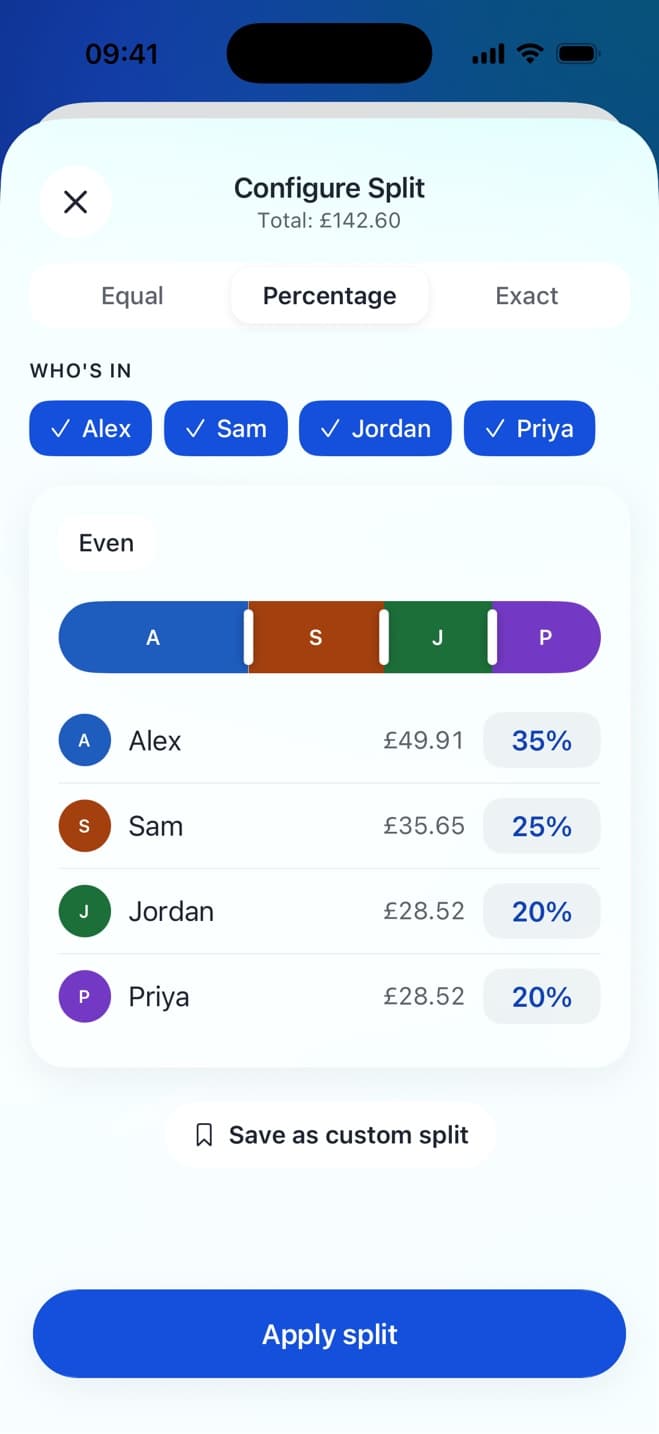
- Equal, percentage or exact splits, with a choice of who's in, so opt-outs and top-ups are easy
- Who owes who, simplified into the fewest payments, and settled with a tap
- Every bill's history, for when someone asks what June's electric was
- Chores, a shared grocery list and a house calendar, in the same app with the same people
To be upfront about the limits: Free covers 2 people. A house of three or more needs Pro, and one Pro covers up to 6 roommates for $34.99 a year, which is $8.75 each in an apartment of four. Your first month of Pro is free. House Plan is on iPhone; Android is coming soon.
Comparing apps? See how House Plan compares with Splitwise, or what it does for roommates.